OnyxAI Studio
AI Operations Review
Production operations / role-scoped workflow / QA gating

GraniteApp Production Operations

A shared countertop-fabrication operations system that moves jobs and pieces through six role-scoped workstations, full-job quality review, repair loops, and QA-gated load-out.

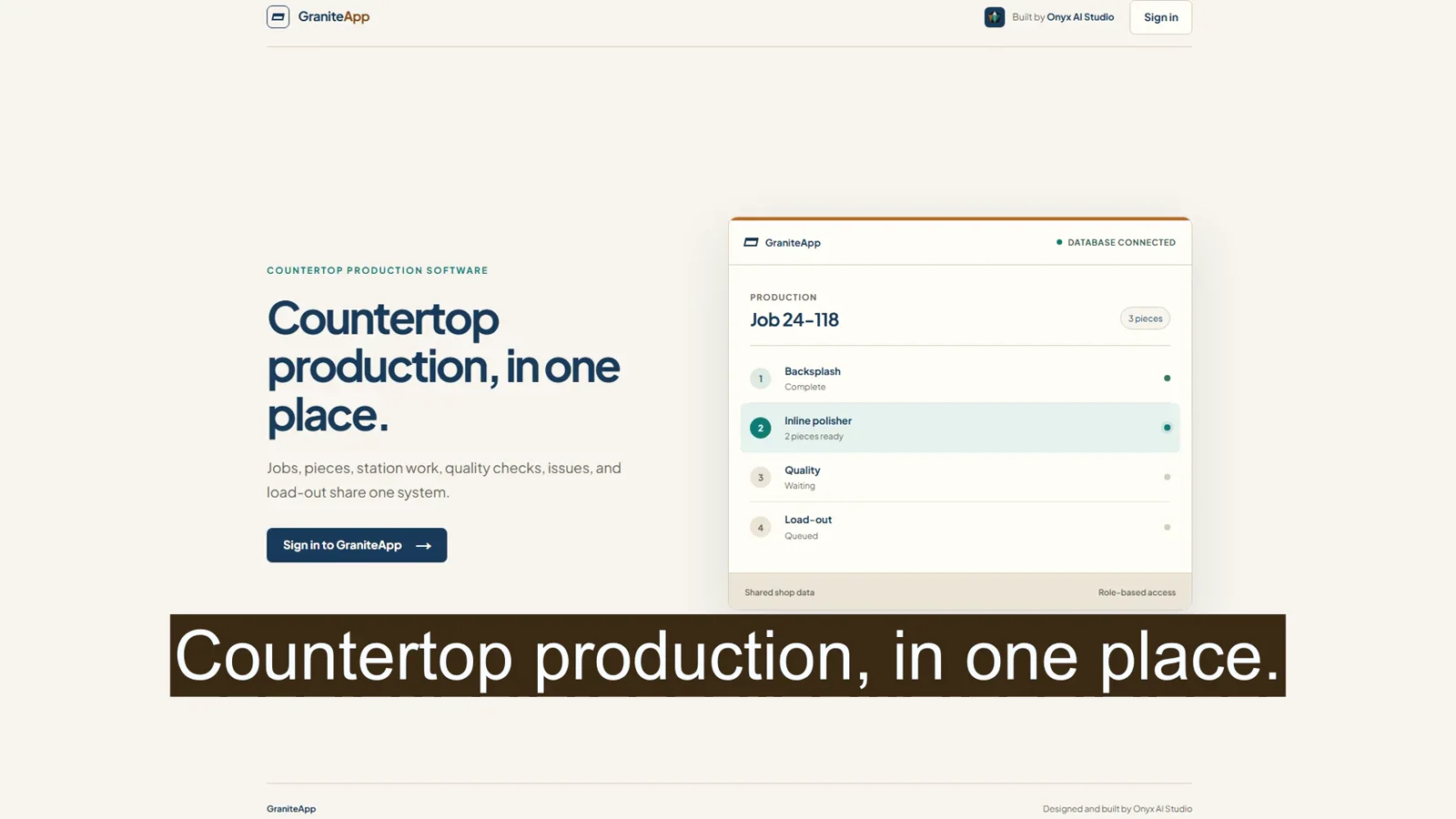
GraniteApp production overview showing a shared job moving through backsplash, inline polisher, quality, and load-out stages
A narrated 75-second walkthrough of shared job records, role-scoped station work, marking handoff, full-job QA, repair routing, QA-gated load-out, and management visibility. Captions are burned into the video. Audio does not autoplay.

Proof depth

What this case study proves operationally.

The strongest proof is the workflow shape: what the visitor or staff member gives the system, what the business receives, and what follow-up becomes possible.

Shared jobs and role-scoped stations

Every job and piece begins in one shared record. Six station roles receive scoped workstation views so backsplash, inline-polisher, marking, QA, issues, and load-out work stays connected without giving every operator the same screen or permissions.

Marking hands the full job to QA

Completing individual marks does not quietly release isolated pieces. The marking operator explicitly sends the completed job to full-job QA, preserving a visible handoff between production completion and quality review.

Issues and repairs return to quality review

QA can route a problem into an issue and repair path with the affected piece and job context attached. Repaired work returns to QA instead of bypassing the quality gate.

QA-gated load-out and management visibility

Nothing reaches load-out before QA release. Management can see workload, active issues, job readiness, and bottlenecks across the same shared operational state.

75 sec

Narrated demo

6

Station roles

Full-job QA

Quality gate

The Challenge

Countertop production can scatter job status across people, stations, paper notes, and verbal handoffs, making it harder to see what is ready, what needs repair, and what may safely reach load-out.

The Solution

GraniteApp keeps shared job and piece records behind six role-scoped workstations. Marking releases a completed job into full-job QA; issues and repairs return through QA; load-out stays gated until quality release; management sees workload and readiness across the shop.

The Result

The working product demonstrates one operational thread from job intake through station work, marking handoff, full-job quality review, repair return, and controlled load-out without exposing production records on the public Onyx site.

Stack and service links

The useful details stay connected.

Case studies should feed service pages, and service pages should point back to relevant proof.

Next step

Have a similar operation that needs structure?

Request an AI Operations Review